|
|
|
Second installment, copyright 2018, Dean Adams Curtis
Chapter 6 Arayat Carabao hooves trod straight ahead. Antonio, a sun-weathered farmer, holds a rope tied to the bovine harness and guides the animal to walk a straight line with a stick. He shares the carabao with other neighboring farming families, cousins of he and his wife. The harness distributes the weight of a blade of metal, a wedge that it pulls that turns over dirt of his field. James, the five-year-old son of the farmer, steadies his three-year-old sister, Mary, as they both stand on a wooden platform using their weight to hold down a tilling blade that is attached below the platform so that it continues to slice the ground. Together, the farmer and children, carabao and blade, cut and separate the earth to make it ready to take seeds they will plant in the Philippine province called Pampanga. Mary gazes across their field and up at the nearby volcano called Arayat. James knows his father is sick with something. He sees him wipe sweat from his face. He hopes he will get better soon. He sees his mother at work harvesting rice from their rice paddy. He envisions minnows of the dalag fish that they maintain in the paddy swimming around his mother's feet.
Chapter 7 Davao He wipes blood away from a leg gash he has just finished stitching up. A nurse bursts open the operating room door. "Doctor, come see!" she insists. The doctor follows her out of the room. "What is it, Doctor?" asks his patient, who gets no reply. Davao has a marvelous bay and good port facilities that had attracted the U.S. Navy to use it. But American naval vessels are not present at present. The doctor, whose last name is Brokenshire, decided, when he retired from the U.S. Navy, to continue his post-military life in Davao. He took over a small clinic that had been started by an American couple, missionary folks. Doctor Brokenshire provisioned it with medical supplies offered him by the U.S. Navy. For the past two years he has been providing medical care to Davao's friendly people. Together with the nurse at a window, Brokenshire looks out to a large and rectangular Japanese-flagged ship. From that seeming wall above the water, a dozen boats that the doctor recognizes to be Japanese marine landing crafts are heading toward the Davao shore.
Chapter 8 Leyte "Dito!" (Here), she calls out to him. He is a Boy Scout. At their school, he is two grades ahead of her, so they had moved unaware of one another in different rooms until she had fixed her interest on him, in his uniform with a red neckerchief at a school assembly. He had given a speech about being trustworthy and helpful. She liked what he had said. She imagined that she had fallen in love with him then. At a halo-halo cart outside their school, she could barely comprehend what was being said by a man's voice coming from the radio hung on the cart. She calls out to him again. "Dito!" Her command catches his attention, as well as that of other boys and girls leaving from their school. But it is him she is obviously waving to her side. He arrives beside her. She points to the radio. The radio man tells them about the Japanese attacking the Americans in Manila and around the Philippines, and in a place called Pearl Harbor, Hawaii. The boy and girl are on the Philippine island of Leyte, an island north of Mindanao, in a city called Tacloban. The radio report ends. He asks her if he might walk with her toward her home. They stop at a lipa hut. She has never sat alone with a boy that was not in her family before. The two of them focus their eyes out at Leyte Gulf. Slight waves lightly brush up against the of Pacific Ocean shoreline. The peaceful scene contrasts the news they have heard. "Hapones mag (will) pagdating (be coming) dito," he says. "Totoo?" she replies, 'really'? He nods, still staring out into the gulf.
Chapter 9 Malacanyang DECEMBER 20, 1941
The hallway is decorated for Christmas, but Philippine Vice President Sergio Osmena is not in a holiday mood. Beside Osmena, walks Manuel Roxas, a Philippine Senator and a general in the United States Army Forces in the Far East, who has a grim look on his face. Together they enter the offices of Philippine President Quezon in the Malacanyang palace along the Pasig River in Manila. "Maligayang Pasko," Quezon says Merry Christmas with ironic intent. "Maligayang Pasko," Osmena replies. "Maligayang?" Roxas questions. The heads of the three men waver with sadness at the dire situation. "Time to go, Mister President." Quezon glances out the window to the Pasag River, at the American "patrol-torpedo" boat that MacArthur has sent for him and his family, that he has just watched dock. "Osmena will follow you in another PT boat two hour later, after we receive confirmation of your arrival on Corregidor. I will join you there tomorrow." "Wala (nothing) maligayang dito," he states. The president's wife, his young daughters, and son, arrive at the door. Quezon stands and puts a hand on Roxas' shoulder. "Salamat po."
Chapter 10 Manila Hotel DECEMBER 24, 1941
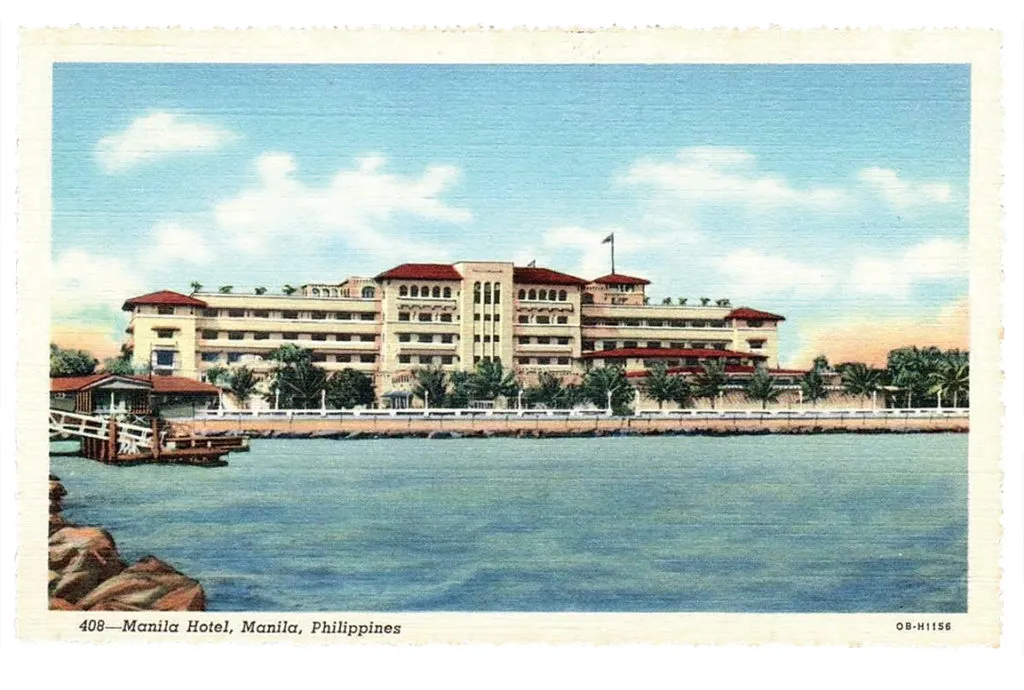
General Douglas MacArthur gives his son a hug. "Are you all packed?" "I will be soon, father," the boy assures. "Good, we are moving to your favorite tunnel for Christmas. Now, go help your mother." MacArthur stands looking southward out a window of his suite atop the Manila Hotel where he has lived with his family for the past six years. Father, I've prepared for this my entire life. He thinks back to stories his father told him about half a century earlier. It had been in 1889, a month after U.S. Commander Dewey had led a surprise attack on the Spanish fleet that lay at anchor in Manila Harbor during the Spanish American War. MacArthur's father, General Arthur MacArthur, Jr., advanced toward Spanish positions, leading his men up the Pasay Road toward their objective, the town of Malate, that then had been at the southern entrance to Manila, but now was a part of the city. His father's new, hurriedly-formed, U.S. 8th Expeditionary Force force was one of three that had been formed in America and sent quickly to the Philippines after Dewey's successful attack on the Spanish fleet. His father and his men encountered and overcame Spanish resistance from within blockhouses, from Spaniards dug into trenches, and men hidden within the jungle. When they reached Malate, his father's orders were to hold bridges until reinforcements could arrive. Will the Philippines be able to hold out now until reinforcements arrive? General MacArthur focuses far out the Manila Hotel window along the edge of Manila Bay. He can just see the Malate area along the shore. A battle for Manila now would be brutal. His thoughts are interrupted by the arrival of his key aid, General Sutherland. "We still have a strong hold of the ground north of Clark," says Sutherland. "But the Japs are making steady gains. They've already gotten to Tarlac." MacArthur readies to give the order he knows is necessary. He feels as though his father is beside him, watching him as he replies. "Spread the word. Orderly retreat of all U.S. personnel from Manila. Declare it to be an open city. And initiate our Plan B. I want everyone on the other side of Manila Bay on a perimeter defending Clark, Subic, the Bataan Peninsula and Corregidor." Sutherland stares at him. He knows the plan well, yet still he is stunned. "It must be done," MacArthur responds to the look on Sutherland's face. "So do it, now."
Chapter 11 Bulican DECEMBER 27, 1941 The eldest daughter of the Valenzuela rice seller, Juanita, rides in the back seat of a red Nash Rambler sedan, looking out over her car-mates at vehicles stopped ahead of them in a traffic jam on a straight road through rice paddies in the province of Bulican, north of Manila above the bay. Through the windshield, Juanita sees a disturbance ahead. Occupants of vehicles before her hurry to get out of them. Next, she sees distant planes appear before them and bombs exploding. Juanita yanks up her door handle, hurriedly exits the vehicle, runs away from the road, and dives into a dry rice paddy. Instinct forces her eyes tight shut as she buries her head between and beneath her arms. A plane flies over, impossibly loud. An explosion. Juanita feels weightless as the earth repercusses the bomb blast and throws her into the air.Smack. Her face hits dirt. She hears nothing. Then, she hears muted cries over loud ringing in her ears. She lifts an eye from her arms and opens it. She sees three planes flying away, gaining height, not turning back. Near her, into her view of the vanishing aircraft, lifts the soiled head of a red-haired American soldier. "I will never get used to that," the American says to her. She just barely perceives the words over the high-pitched ringing. English? Her brain works to translate what the person has said. The girl begins moving away from him with a snakelike shimmy. "Sorry," he says, rising to his knees, "Rocky Riddle, United States Far East Air Force, or FEAF for short." Juanita's body, pumped by adrenaline, pushes her to her hands and knees, preparing her for flight. "Do you speak English?" His question reaches her cortex. She glances around and sees no obvious place to run. Her mouth moves as her jaw sends her pain signals. Her lips open. "Yes." "Is that the car you were in?" Juanita follows Rocky's gaze. The Nash Rambler is a twisted smoldering hunk of metal with tires ablaze. "Family?" "Neighbors." "Sorry." Rocky points her attention to a truck with its front engine compartment and driver's seat blown apart that is behind the smoldering car. "My truck. The Japs destroyed our aircraft at Fort McKinley. I'm shifting our radio equipment to Clark." Juanita wonders why is he talking to her again as if they have been long acquainted. Rocky stands. "I had better check what radio gear I can salvage," he concludes. She stands and stumbles toward the remains of the Rambler, looking for her neighbors. What she finds of her deceased neighbors immediately nauseates her. She staggers back into the dry paddy. Ringing in her ears is lessening, but she is dizzy. Now there is a buzzing. She staggers, then vomits. The buzzing grows louder. She realizes she is crying, uncontrollably. Tears cloud her eyes. She sees a blurry figure rushing toward her and throws up her arms. Rocky tackles her to the dry paddy, his body atop hers. Still full of adrenaline, she tries to buck him off. "Stay down!" Rocky shouts at her, his face pushing hers once again into the dirt. "More coming!" A trio of Japanese Mitsubishi Zeros are on a strafing run, two machine guns fire from each plane, one per wing, six machine gun barrels spewing bullets toward Juanita and the humans, which she sees causing fountains of water and blood to fly up as they impact rice paddies and people. The bullets seem to tear open reality and time, as to her, the instant stretches. Bullets impact around her and sizzle past. Later, she follows Rocky, dazed, drained, joining others in the process of checking the condition of humans they find, as all walk westward along the road, gathering up those who can walk, giving aid to those who are still alive. "Wait," Rocky calls out to those around him. His attention is focused on a Ford tractor, intact, and running. "Whose tractor?" No answer. A man who is walking with them, a dozen yards off, moving through a rice paddy, stops at a bleeding man, prone in a foot of water. "His," says the man. He drags him to the levee beside Rocky, who checks the man for a pulse. "He's gone," Rocky announces. She finds herself examining Rocky as he starts leading those around him. "We're on our own here, folks." He's not a tall man. He's actually the same height she is, give or take an inch. "I'm going to use this tractor to haul U.S. Army Air Force radio gear to Clark, under orders from General MacArthur." What he lacks in height he makes up for in muscle. Rocky spots a flat-bed trailer attached behind a bombed and burning vehicle. "Let's get that trailer hitched to this tractor," he says to the man who pulled the tractor's driver out of the water. "We'll use it to carry the wounded." As the actions Rocky just described unfold, Juanita watches the American closely. He has red hair everywhere she can see.
Chapter 12 Sukimoko At dawn, in Valenzuela north of Manila, Maria, the Sukimoko shop's proprietress, is outside sweeping the entrance to her sari-sari store. Sun beams under an overcast and through a mist of rain, creating orange and rose cloud bottoms and a rainbow. Flowers around her become vibrant. She catches her breath at their beauty. Maria glances across the street, where her cousin Irene has a line of customers for salops of the dwindling rice supply in her various bins. Maria's worries about Juanita, her oldest niece, who raced off with neighbors on a mission that Maria considered to be dubious at best, and of course, given the circumstances, more dangerous than it would usually be. But what could she do? She had advised Juanita against going up into the provences to find her father, who had left his family half Juanita's lifetime before. Juanita never got over that. However, with her next thoughts, Maria wonders whether she should have gone with the neighbors and Juanita, to try to get Emiliano and Francisco to somewhere safer. But where? She wished she knew more about what was going on. Her thoughts are interrupted by a group of three U.S. Army trucks moving fast past Sukimoko and the rice seller's shop, heading north through Valenzuela toward Bulican. She wonders again, "Will my boys and I be safe here." Then, for the first time in maybe three years, she finds herself wishing her husband was home, rather than below the deck of a ship somewhere in Manila Bay, working on an engine, black with grease. Maria becomes aware of Emiliano, who is looking up at her, from a seat where he has been sucking on a cherry flavored shaved ice cup. He begins to cry. "What is it, Emil?" "I'm scared, Nanay." "I know you are," Maria says. She pulls him to her. "I know." "I want you and Francisco to stay close to Sukimoko and be good boys. I need both of you to help me. Can you do that for me?" Her six-year-old nods. "Yes, Nanay." "Glad you're not telling the boy lies," says a voice at the door from the throat of a backlit figure who is immediately recognizable to her, by his voice, and tall silhouette. Somehow her kuya ("coo-yah"), her big brother, had inherited the tall sprout from the diverse Aquino family lineage. It was their grandmother Irene Aquino who had married the common boy from the province of Malabo, one of the Visayan Islands, a group in the middle of the Philippines, south of the big northern island of Luzon, and the nation's capital Manila, where Maria's grandmother Irene was a social butterfly, and Valenzuela was a garden city. "Claro!" shouts Maria, rushing to him, throwing her arms around him. "Magundag umaga, sister." Her brother replies, absorbing the impact of his sister's sudden embrace as if he were the trunk of a large tree. "Look who I found down at the end of the street," Claro says, indicating Francisco, who is kicking the dirt of the street nearby. "Francisco!" Emiliano shouts, as he rushes through the Sukimoko sari-sari shop door and tries to wrestle Francisco to the ground, with the opposite of his intention as the outcome. Emiliano almost cries out for his mother's attention, but sees her entering Sukimoko with his Tito Aquino. "What are you doing here, Claro?" "Mahal kita to you too, sister." Claro says, taking a bottle of cola from the little cooler by the cash register. He opens it with the opener attached to the cooler. "Love you too. Ahhh! You keep them the coolest of anyone else around, sister." He stares at her staring at him. He reaches into his pocket and pulls out a coin, smacking it on the counter. Maria still stares at him. "Okay, I'm going to join the resistance." "What?" Maria asks, "What resistance?" "MacArthur has ordered the Americans out of Manila, which will hopefully save the people here from being slaughtered." Maria sees that Francisco and Emiliano are in the Sukimoko doorway listening. She frowns at her brother's harsh wording, but he continues as if he doesn't notice, which of course he does, as there is no expression of sister's that he hasn't seen and long ago adjusted to. "And Quezon has ordered resistance to begin in all Philippine provinces, I'm heading for Mount Arayat and the forces assembling under the leadership of your old boyfriend." The emotions that Maria experienced at her brother's allusion to James Cruz surprised her. Claro analyzes his sister's reddening face, but says nothing more, as her boys are listening. "No!" Maria shouts at Claro. "You can't join him. Stay here with me and the boys. Please." "For tonight, then." "Salamat po."
Chapter 13 The Blooms Down the street from Sukimoko, and from his elevator warehouse, Anthony Bloom pulls his deep blue Chevy up to the gate outside his home. He gets out, unlocks a padlock, unwinds a chain, and pushes the wrought iron gate open. He pulls his Chevy into its parking space, while keeping his alert eyes searching for a sighting of his wife, or any sign of trouble. Inside the house, nobody is in the greeting area, the living area, the dining area, or the kitchen. "Sweetheart," Anthony Bloom calls upward as he ascends the stairs. Silence. He calls out his wife's name. "Persephone?" No reply. He approaches the master bedroom. He does hear something. He opens the bedroom door and finds his wife weeping in their bed. She sees him, and her sobbing stops with a gasp. She instantly levitates and is into his arms. They hold onto each other tightly. He kisses her hair, at the crown of her head. She feels his kiss as a jolt that runs down throughout her entire body. In the next moment, she catches a slight smell, a familiar fragrance. Instead of issuing an admonishment, her lips rise to his. Her kiss ignites him. They escape the horrible external reality of their living situation, which neither of them is yet even remotely ready to face, into a heated cocoon of lovemaking, enwrapping one another, thrusting away all but their present. It is as if it is their first time. Deep in the night, holding a tight cuddle, Persephone whispers to Anthony, "I smelled her on you again." "Who?" "Whoever she is, whatever her name, it ends now. We need to hold onto one another and focus on how we get out of here." "I agree, My Love. I'm sorry." "So, what now?" Persephone Bloom, always the pragmatic planner, asks Anthony. She once thought was also a good planner but now recognizes he is weak in that area, as they have a full warehouse of elevator components down the street and no customers. "There are no reports of allied counterattacks." "Don't worry, Sweetheart, our boys will be coming to the rescue soon. We just have to ride this out." A few moments after that confident statement, Anthony falls asleep. As a night breeze flutteres her white lace curtains, Persephone sheds a tear.
Chapter 14 Intramuros Undercover Japanese agent, or with more precision, Naval Intelligence Captain, Yoshi Imai, is daydreaming behind a bar in Manila, serving as a bartender at the Intramuros Golf Course clubhouse, looking out at the rain gray sky and wet darkened rocks in the walls of the old Spanish fortress which the golf course surrounds. Yoshi is daydreaming of his gardening days, back when he would mindfully and peacefully rake rocks into patterns, creating sukiyama, artificial mountains within sandscapes and featuring bonsai trees he had crafted since his childhood. Back in Japan, he was at the top of his class in everything, but due to the influence of a peaceful uncle who died during his childhood, he had gained a love of gardening that became his passion. That was before the militarists began their war plans for Asia. Soon after that, his former classmates, who knew of his brilliance and his sociable way of getting along with everyone, contacted him. They had joined the secret kempetai after school, all the smartest had joined, and had formulated an astonishing secret plan in which Japan followed up on military successes in China and Korea, by liberating Southeast Asia and the South Pacific of colonialization by European countries. Replacing colonialism by one nation with another, he had thought at the time, several years ago, before they had swept him in after a weekend of sake, sushi, hot baths, and geisha services. He had brought several of the same women with him on his mission, one that he had designed, but had never intended to lead, to lay the groundwork for a successful Japanese invasion of the Philippines and its occupation thereafter. The geishas had already come in quite handy, extracting troves of information from drunk Americans he served at the golf course bar. Agent Imai wipes the bar, thinking about how his year of deception might finally be almost over. Christina Ortegas walks back into his bar. Her familiar voice calls out an order, "Cosmopolitan!"
Chapter 15 Manila Bay Juan Santos is amazed when the piston rod he needs for the ship's engine repair finally arrives on a skiff, two weeks after it was promised. Since taking the repair job, Juan and his coworker had never again seen the ship's owner, an American. They realized they would probably never again see him or their pay. They had remained housed on the ship over Christmas, fishing for their meals and consuming the plentiful rice and canned goods aboard. As the days had passed, they had seen repeated Japanese aerial bombardments of American Navy ships moving on Manila Bay. Smoke rose from half sunken ship hulls. There were so many ships that the Japanese could not possibly target them all, they figured. So they had stayed anchored near shore. He and his coworker haul the piston rod up using a chain and pulley and swing it into a hatch they have opened in the side of the engine room. The man on the skiff ties off his craft and climbs up the chain. Juan offers a plate of fish and rice to the piston rod delivery man and observes him as he rapidly consumes the meal. Juan's thoughts return to his wife Maria and his children Francisco and Emiliano. He and his wife had fought bitterly before he last left home. Would Maria want to see him? As if in answer, inspiring thoughts and words suddenly enter his brain. He finds a pencil and a sheet of paper. He begins writing his wife a poem.
Chapter 16 Intramuros The six men meet in a storage room behind the Intramuros golf course club house bar. Manila is still full of Americans. In case they are overheard they speak in the Tagalog language they have trained to use, or in English. They swap information they have heard, about how the Japanese military is fighting their way toward the city from both the north and south. Two of the geisha agents who have been working for Japanese Naval Intelligence Captain, Yoshi Imai, pretending to be Filipinas, arrive with tea, and news that the Americans are evacuating from Manila. All eight Japanese citizens are excited that their time in disguise will be ending, and that their reign over the seven-thousand-island archipelago will soon start. Soon, they all know, they will serve as a Japanese intelligence steering committee for the Philippines. "We need to begin preparing to assert control in our assigned operational areas," Yoshi say in Japanese. Christina Ortegas enters the clubhouse bar at the Intramuros Golf Course in the heart of Manila. It's dead. One of the girls, the tall one with the incredible legs, who she had often noted the bartender setting up with clients, is now behind the bar, tending to it by stocking shelves with bottles of alchohol. Come to think of it, she ponders, she has been noticing something off with the girls that the bartender was pimping. While they all acted like Filipinas, they never would speak to her. And when she heard them talking with customers she could tell that they spoke Tagalog with a strange accent she couldn't place. Maybe Chinese? Could they be Japanese? Her train of thought is cut short as the woman tending the bar suddenly turns and looks directly at her. There's a deadly serious new look in the girl's eyes that chills her. She looks away quickly, her eyes scanning the empty golf course. When she glances back, the female bartender is still looking at her.
Chapter 17 Bulican A tractor pulls behind it a flatbed trailer filled with crates of radio gear and Filipinos. Rocky turns back from the driver's seat of the tractor to Juanita, who is sitting on a crate at the front of the trailer, moonlight illuminating her eyes. "Sorry about your neighbors," Rocky says. "Where was it you were headed" "Angeles City." Rocky nods. "At this rate we should be nearing Angeles and Clark Airfield by dawn."
Chapter 18 Valenzuela From the rice sellers shop, Irene's 16-year-old daughter, Conception watches as her cousins Francisco and Emiliano rush about playing war with sticks as guns. At that moment, beyond the boys, down the street, appears a scene that it takes her a moment to fully comprehend. Japanese troops, march toward her and the boys in formation. Francisco and Emiliano stand still and drop their sticks. Suddenly, a white-haired Filpino man with a rifle steps from between Conception and the two boys, and the Japanese, shouting at the newcomers with words she is too far away to hear.The leader of the Japanese platoon steps forward toward the Filpino, who then aims his rifle. The platoon leader quickly swings up a pistol that he had been holding behind his back, and fires a shot at the white-haired man. Francisco and Emiliano back into the entrance of Sukimoko as the Filipino drops dead to the street. Inside Sukimoko, Maria, who has been startled by the gunshot, grabs her two boys and hurries them out the back of the sari-sari shop
into their house, then shuts and bars the door.


StudioinaStudio |