|
|
|
Third installment, copyright 2019, by Dean Adams Curtis
Chapter 19
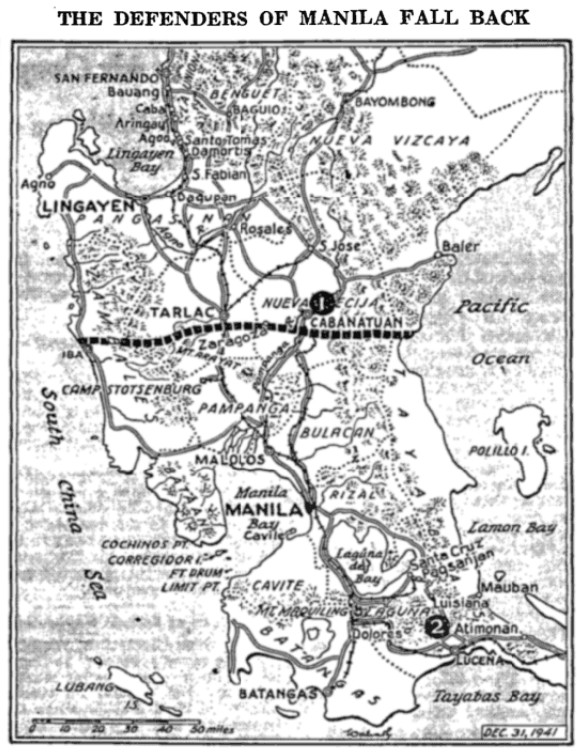
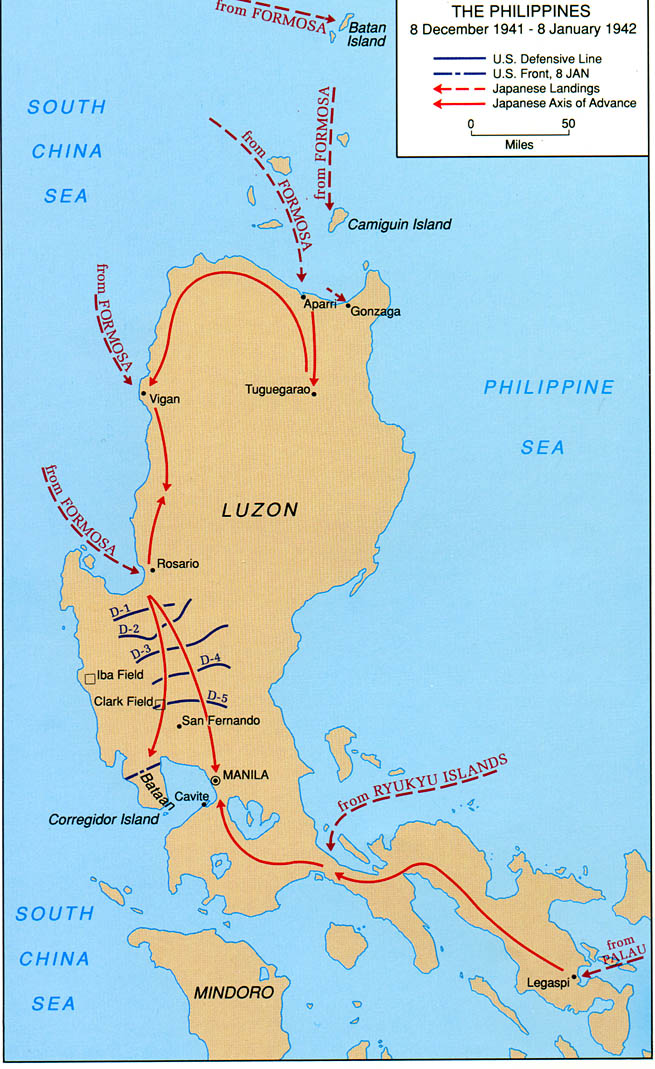
DECEMBER 30, 1941 "Never before in all history has there been a more solem and significant inauguration," his father said during his short speech. "An act symbolic of the democratic processes is placed against the background of sudden merciless war. For 400 years the Philippines has struggled upward to self-government. Just at the end of its tuitionary period, just on the threshold of independence came the great hour of decision. The whole country followed its great leader in choosing the side of freedom against the side of slavery. Hand in hand with the United States and other free nations of the world this basic and fundamental issue will be fought through to victory. Come what may, ultimate triumph will be its reward. Through this, its gasping agony of travail, through what Mr. Churchill calls 'blood and sweat and tears,' from the grim shadow of the valley of death, O merciful God, preserve this noble race." Now, Arthur's father again seats himself beside him. Arthur, watches the Quezon children, as their father, the president, stands up and walks to two other men who have moved to stand beside the microphone. They are all attending a swearing-in ceremony for the president's second term. The event is being held outside the west end of the massive Malinta Tunnel on the volcanic rock island of Corregidor in the middle of the entrance to Manila Bay. Around the area where the ceremony is taking place, young Arthur views abundant craters from blasts of bombs dropped the day before by Japanese planes. He recalls the dust that fell then, within the long concrete arched tunnel. The dust fall made it seem as if it was snowing. Jose Abad Santos, Chief Justice of the Philippine Supreme Court, administers the oath of office. Vice President Sergio Osmena also agrees to the oath. Next, Quezon holds onto the microphone stand as he speaks. Arthur's father told him that the day's speeches would be broadcast. "We are in the grip of war, and the seat of government has been temporarily transferred from the city of Manila to a place in close proximity to the headquarters of our armed forces, where I am in constant contact with General MacArthur. All around us enemy bombs are dropping and anti-aircraft guns are roaring." Arthur does not hear any bombs, or any anti-aircraft guns firing. "In defenseless cities and towns air raids are killing women and children and destroying century-old churches, monastaries and schools." Arthur had not heard about schools being destroyed. He worried about the children in them. "At the present time," the president went on, "we have but one task: to fight with America for America and the Philippines. To this task we shall devote all our resources in men and materials. My heart and, I know, the hearts of all Americans and Filipinos in this country are filled with gratitude for the reassuring words of the President of the United States, and for the valuable cooperation he has rendered my administration. My answer, our answer, to him is that every man, woman and child in the Philippines will do his duty." "General MacArthur," the Philippine president said looking at Arthur's father, "there are no words in any language that can express to you the deep gratitude of the Filipino people and my own for your devotion to our cause, to the defense of our country and to the safety of our population. I trust the time will come when we may express this sentiment to you in a more appropriate manner. "My fellow countrymen, this is the most momentous period of our history. As we face the grim realities of war let us rededicate ourselves to the great principle of freedom and democracy for which our forefathers fought and died. The present war is being fought for these same principles. It demands of us couage, determination and unity of action." Immediately after Quezon finishes his short speech, Justice Santos, beckons the president to his side away from the microphone. He also gathers to him VP Osmena and Manuel Roxas. "Just before I came to Corregidor, I received word that our old compatriot, General Ricarte, has returned from his self-imposed exile in Japan along with the Japanese. He has been writing to me. He is quite clearly a fan of the Japanese plan for what they call their Greater East Asia Co-Prosperity Sphere. There is no doubt he will be seeking out Aquinaldo." Then, the air raid siren begins to scream. Deep in the tunnel, a radar display screen shows blips indicating another flight of planes is moving out of the northwest toward Corregidor.
Chapter 20
The broadcast of the president's speech on the radio ends with a noise called static. Maria wishes her husband Juan was with her. She pushes the thought from her mind and focuses on restocking the shelves of Sukimoko with the various fruits and dry goods she has sought out by walking with her boys to her local suppliers. There would be no more regular deliveries to her for the time being. She looks across the street and gives a wave to her cousin, Irene, who she knows is well stocked with rice, though Irene, she also knows, is keeping that fact hidden away in a secret cellar storeroom, and by only partially filling some bins at the front of her rice shop and leaving other bins empty. "What's going to happen, Nanay?" her little Emiliano asks her for the umpteenth time. "I don't know, Emil," she replies to him once again. "We will have to wait and see."
Chapter 21
Doctor Brokenshire watches the Japanese patrol. They're coming for me. "Leave out the back," he tells his nurses. Instead, both of them walk out the front door and stand on the veranda facing the approach of the Japanese. Brokenshire follows them out. Moments later, the captain who leads the patrol pushes the nurses aside. "Doctor," he states. Then, in flawless English, he continues. "Come with us." When the doctor does not move, the captain wraps a hand around a bicep of Brokenshire's. "Now." With a strong tug he pulls the doctor off his porch into the grasp of his men.
Chapter 22
Activity everywhere. All things in motion. Juanita rides on a crate at the front of the flat-bed trailer loaded with radio equipment and Filipinos wounded when the Japanese planes shot up their vehicles on the road. The trailer is being towed by a tractor with the American Rocky Riddle at its steering wheel. A rumble from the sky becomes a roar. Her body reacts, readying her to run for her life. "They're American planes!" Rocky shouts back toward her, and those with her on the trailer. "Unfortunately, they're our last!" All Juanita hears is "American planes." She visibly relaxes. That's when she sees the men coming from an intersecting steet. They are Filipinos, marching in synchronized steps, at least two hundred men in loose-fitting olive drab green uniforms and with full packs on their backs and rifles slung over their shoulders. They're led by an American captain. "Philippine Scouts," Rocky calls back as he puts the tractor's gear shift into neutral. "Heading to the front." The sight of the Scouts stimulates in Juanita an upwelling of pride in her countrymen. When all the Scouts finally pass, Rocky puts the tractor back into gear. The trailer that Juanita rides on moves ahead. That's when she sees a Scout, who is hurrying to catch up to the back of the column, stumble and fall, unseen by comrades that march on ahead. Juanita notes that the Scout who has fallen seems to have twisted an ankle and is having a hard time standing. She jumps off the slow moving trailer. "Rocky! Salamat po!" Juanita shouts to the American. She then hurries over to help the Scout. Rocky watches her go, while at the same time glancing back at the slow moving traffic ahead of him. 'She's something special,' he thinks to himself, silently wishing her well. He takes a deep breath. He's done his bit. He got her safely to Clark. She, and the others on the trailer behind him, some of whom are also now following Juanita's lead and getting off, are now within the safety of the protective U.S. defensive perimeter. Juanita arrives to help the Scout. 'Good luck,' Rocky thinks, then turns his full attention to navigating the tractor and its trailer through a throng of humanity and vehicles. Juanita kneels to help the Scout, and is startled at the feminine-looking face and eyes that meet hers.
Chapter 23
Maria jumps, startled. She does not have many customers who she does not know. A silhouetted man has appeared in the Sukimoko doorway, blocking much of the sunlight from entering. Her eyes adjust. The man who has appeared in her doorway is clean and trim, dressed in a white formal barong shirt. He opens his arms to her. Only then does she realize he is her husband. She rushes into his embrace. "What happened to your grease?" she asks with her head pressed against his chest. He cannot answer her. His eyes pour out tears and emotion constricts his throat. Emiliano and Francisco enter Sukimoko through the back and rush to their father. "Tatay!" shouts Francisco, who then embraces both his mother and father. "Tatay, tatay!" shouts Emiliano who adds himself to the family embrace.
Chapter 24
The pilot of the Mitsubishi Zero, Hideki Shingo, looks at his fuel guage on empty and pushes back fear. He looks out at the flat gray view that surrounds him inside a cloud. He checks another guage, his heading. Still on course, north, three degrees northwest, heading for the airfield at the southern tip of Formosa, an island that was formerly China's, but which has been under Japanese occupation for years now. A prayer to his ancestors, uttered silently by slightly moving lips, is all he can do, other than what he is already doing, to get he and his plane back on the ground alive and in one piece. He's been trained for this scenario. And he's trained other pilots of his squadron in what steps to take if it happened. Now cloud blind, he lacks any targets to aim a crash attack against, he stays on course for the base. The Zero pops out of the cloud into clear sky. Before him across a short expanse of the South China Sea, is a sight familiar to him, the rugged mountainscape of Formosa. He takes a deep breath, and exhales.
At that moment, the Zero's engine starts to sputter. In another moment, it quits operating. The propeller's spin slows, then stops. Hideki's Zero becomes a glider.
Chapter 25
USFEAA Nurse Maggie Farrell McCormick, who heralds from John Steinbeck's, Salinas, Californa, is up to her elbows in blood, and spattered with it everywhere else about her. The other nine nurses in the airbase's infirmary are also. They have been forced by multiple attacks on Clark by waves of Japanese airplanes to become surgeons by necessity The only doctor at the airbase was killed by the first Japanese bomb. Somehow the Japanese got to us at exactly the right moment. Nurse Maggie muses as she stitches up an airman's gut wound. They destroyed all the B-17s and fighters, She and the other nurses had flown in from California on a B-17. A short muscular USFEAA sergeant appears at the infirmary door. Rocky directs his statement to her. "I've got a trailer full of wounded outside." As the sergeant guides in Filipinos for her care, Maggie performs triage, accessing their wounds, guiding them toward her nursing team. Later, as Maggie stitches a wound on Rocky's back, another American, Captain James Truebridge, who is the airbase commander following the death of the prior commander the day before, in the violent maw of a Japanese bomb blast, appears at the infirmary door with news he broadcasts in his booming voice so that none can miss hearing it. "Pack up! You've been redeployed to Fort Mills on Corregidor! Your plane leaves at 17:00 hours." 


StudioinaStudio |